A question she can answer
Last night I asked Sara whether she knew yet how the game should go on. We have a prologue running now — a real one, playable end to end — and beyond it the map is open. She thought about it, and said she didn’t know.
My first instinct was to file that under not yet. It isn’t. The problem was the question.
The wrong shape
In the last entry I wrote that what her injury took most of is initiative — the small spark that proposes things. Then I turned around and asked her to propose the entire second half of a game. That is the single most initiative-shaped question I could have built. It asks her to reach into an empty room and come back holding something.
Choosing is a different motion from proposing. Recognising something and saying that one costs a fraction of what inventing it from nothing costs — for everybody, and much more so for her. I’d been treating both as “asking Sara,” as if they were the same act. They are not remotely the same act.
The right shape
So we stopped handing her the blank page. What she gets now is two or three concrete things, and a question she can close in about ten seconds. The room ahead has to feel wrong — is it worse if it’s too tall, or too narrow? There’s a sound in the dark: high and thin, or low and slow? This colour, or that one?
Every one of those is a real decision. It goes into the build, it ships, it’s hers. Nothing about it is a practice exercise, and I think that matters more than the format does — she can tell the difference between being consulted and being kept busy, and so can anyone.
Three rules we’ve landed on, all learned the hard way:
- Never more than three options. Four is a blank page wearing a disguise.
- No right answer. If I’d be disappointed by one of the options, it doesn’t go on the list. She’d hear it anyway.
- Show, then ask. A thing to look at first. Choosing between two descriptions is still mostly imagining.
What we notice
Here is the part I want to be careful with, because it’s the part it would be easy to oversell. We are two people at a kitchen table, not a study. But this is what we see: when the choices are small and real and there are lots of them, she starts adding things we didn’t ask about. Not every time. But it happens — a third option we hadn’t thought of, an objection to the whole question, a no, but what if. That’s the spark, arriving under its own steam.
I don’t know whether that generalises past one person and one kitchen. I do know that the days with ten small doors in them go better than the days with one big one.
The game was already doing this
What took me a while to see is that the design had worked this out before I did.
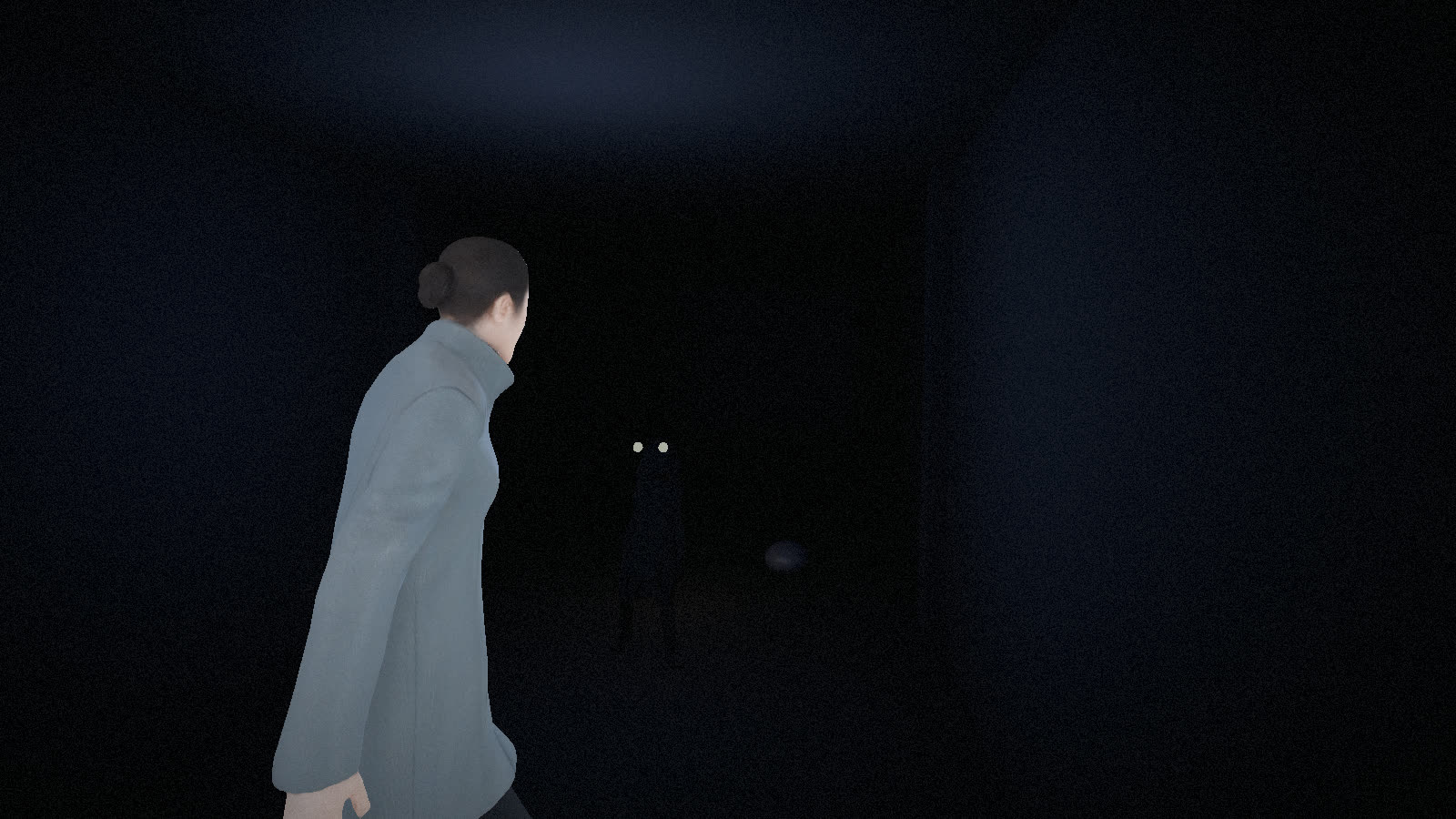
Escape Something never asks the player an open question. There is no dialogue tree, no inventory to puzzle over, no blank field waiting for a clever idea. There is one question, asked continuously and without words: do you look back, or don’t you? Two options. No right answer — looking back costs you, and not looking back costs you something else. You can close it in about a second.
That’s the same door, built for a stranger instead of for Sara. I’d like to claim I planned that. What actually happened is that the game was designed around what she could do, from the first evening onward, and it kept that shape without either of us naming it. Naming it now has made me stricter about it — every screen gets held against the question of whether it demands invention when it could offer a choice.
Where that leaves the second half
The plot has been written for a while; that was never the open part. What’s open is everything the plot doesn’t decide, which turns out to be most of what you actually feel while playing: how a room is wrong, what a sound does to your shoulders, which of two silences is worse. That list is long, and it’s hers to work through, a few doors at a time, whenever there’s room for it.
She still doesn’t know how the game should go on. Neither do I, in the way the question meant. We know the next ten choices, and that has turned out to be plenty.
Next entry, the one I promised last time and owe you: sound, and how it tells you how close something is without a single word.
Read the real story → Follow the build →