Ten doors
Last entry ended on a rule: stop handing Sara a blank page, hand her two things and a question she can close in ten seconds. Writing that down was the easy half. This is what happened when we built it.
What it is
A separate little app, not part of the game. Two images, one screen, nothing else. Tap the one you want. Swipe down if you’d rather not answer today. Hold to see one of them full-size. A row of dots along the bottom tells you how many are left, and that row is the entire user interface — there is no text anywhere in the thing. Not a title, not a label, not a button. We checked that the way you’d check anything else: the automated test asserts that the page contains no readable text at all, and it fails if a word ever creeps in.
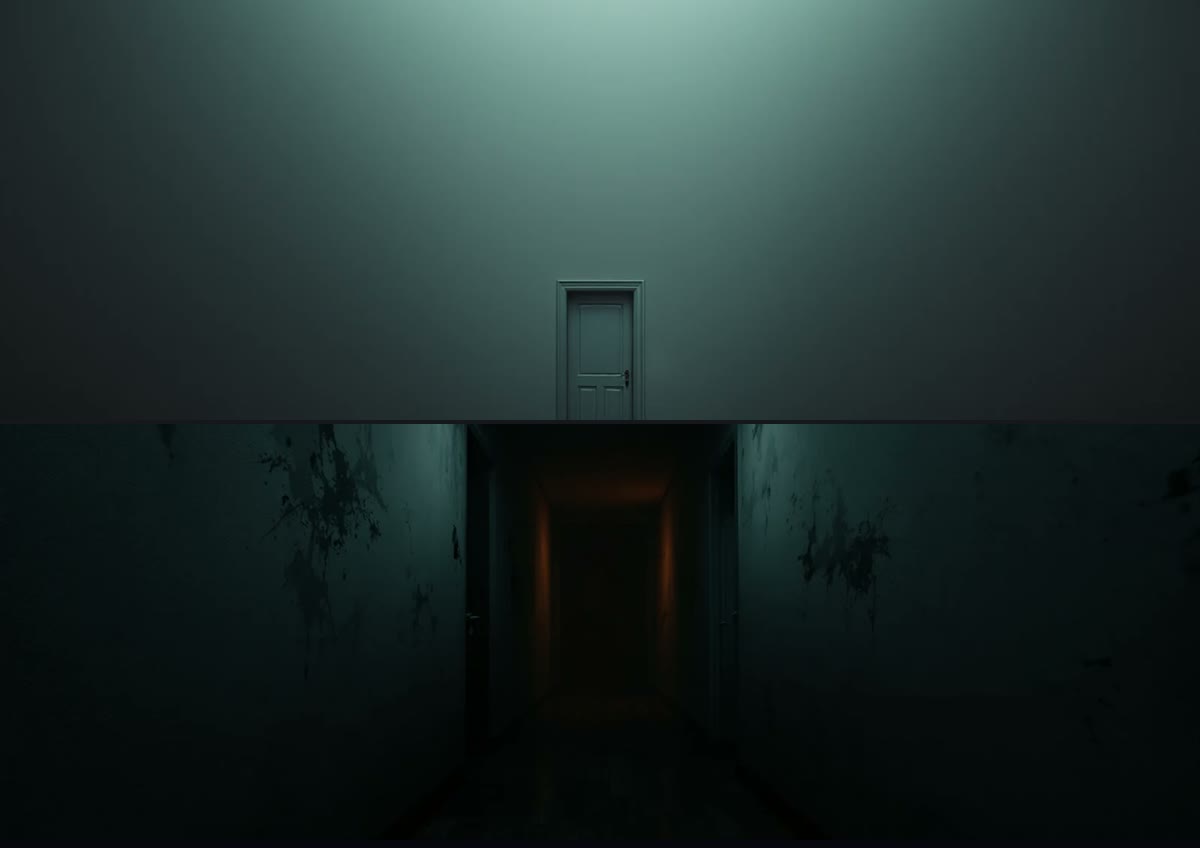
That’s a real question from the real set. The hallway in the house has to feel wrong, and there is more than one way to be wrong: a house that grew too tall around you, or a house that is closing in. Both are buildable. Both change what the rest of the chapter feels like. Neither is correct.
The part I didn’t expect to spend a day on
Most of the work went into what the tool refuses to show her.
Before a set can be used, it gets checked. Two options exactly — three would be a blank page wearing a disguise. Both images must exist. Neither may be missing. And the two must not be the same file, which sounds absurd until you copy-paste a line in a config and hand someone a choice between a thing and itself.
The check I’m proudest of is the boring one: both images must be exactly the same size. If one is a little taller than the other, the screen shifts when the pair loads. It’s a few pixels. But a movement at the moment a question appears reads as emphasis, and emphasis reads as this one — and then it isn’t her choice any more, it’s mine, smuggled in through a layout bug. So a size mismatch stops the whole set from being used.
Same reasoning behind a smaller detail: which image goes on top is decided per question by a fixed scramble, so a run of top-half picks means something about taste and nothing about position.
Two of the ten got thrown away
We render the variants rather than photograph them — that’s how the art in this game gets made, and it means a question can exist the same afternoon it’s thought of. It also means the first attempt is often wrong, and the rule from last time turns out to have teeth: if I’d be disappointed by one of the two options, it doesn’t go on the list.
The hallway pair failed first. Too tall and too narrow came back looking mostly like bright and dark — a difference, but not the difference. Remade.
The sky pair failed worse. One of the rooms opens onto a sky that is the wrong colour, and the first render came back a hard saturated red. Saturated colour is on the forbidden list in our own art direction, written months ago and binding. Remade — and the second attempt came back a rather beautiful sunset, which is arguably a worse failure. A sunset is explained. The whole point of that sky is that nothing explains it. Third attempt: a flat amber haze with no sun anywhere in it, no source, no time of day. That one goes in front of her.
Three renders for one half of one question, on a tool where the entire interaction is a single tap. That ratio feels about right.
It does have a price, and since we said we’d show the wrong turns as well as the finished thing: ten questions took twenty-five renders. Twenty of them are what she’ll actually see; the other five I threw away before they ever reached her, for reasons no one but us would have noticed. Each one costs a little. Individually it’s nothing, and across a game it is the sort of number you keep an eye on. We’re not asking anyone to cover it — there’s nothing to back yet and no way to do it. But when people ask what “building it in the open” costs, this is the honest answer: mostly it costs the work, and occasionally it costs a sky you decided wasn’t wrong enough.
What she never sees
One of the ten questions is marked as internal and can never appear in an entry like this one, because the pair gives away more about the story than we’re willing to give away yet. That marking lives on the question itself rather than in someone’s head, so the decision about what stays private is made once, at the moment the question is written, by the person writing it.
The same goes for her answers. What she chooses is written to a file that stays on our machines. It isn’t published, it isn’t anonymised and published, and it isn’t going to show up here as a chart. We record which option won and nothing else — no timings, nothing about how long anything took. That is not data about Sara. It’s data about a hallway.
Why a screen and not a conversation
We could do all of this at the kitchen table. We did, for months, and we still will. But a father sitting opposite you waiting for an answer is a kind of weather in the room, however gently he waits. A screen has no expression. She can open it at eleven at night, do four, get bored, and put it down, and nothing about that is a disappointment to anybody.
Ten questions, then it stops on its own. Skipped ones stay away for a day. Answered ones never come back.
Next
She hasn’t used it yet — it was finished this evening. The first ten choices go straight into Chapter 1, and I’ll show you what changed once they’re in. Then the entry I keep pushing back and genuinely owe you: sound, and how it tells you how close something is without a single word.
Read the real story → Follow the build →