You only walk
Sara played the chapter this week. She said the game is cool. Then she said: you only walk.
The whole game is about looking behind you. That is the mechanic, that is the theme, that is the sentence I have written at the top of every design document for four months. She had walked through six rooms without once discovering that she could turn around.
I want to write this one properly, because the interesting part isn't the mistake. It's the method that found it, and the method that has to fix it.
Telling two failures apart
When a player struggles, there are two very different things that can be true, and they look identical from the outside.
The first is a balance failure. The player understands the game and the game is too hard. You fix that with numbers: more time, slower threat, wider margin.
The second is a legibility failure. The player never understood what was on offer. No number fixes that, because the player isn't losing the game — they're playing a different, smaller game that happens to run inside yours.
I have been here before, and I got it wrong the first time. Early on, testers kept dying and saying it felt unfair. My instinct was to soften the numbers. When I actually reproduced it, the truth was that one room never drew the shadow that warns you, so the danger arrived with no tell at all. It wasn't hard. It was invisible. Softening the numbers would have made an invisible thing invisible and slow.
So the discipline now is: before touching a single value, reproduce it, then read the code for the exact conditions the player has to satisfy, and hold those up against what the game actually signals. The gap between the two is the bug. Almost every time, the gap is bigger than I expect.
What the code was really asking for
Three complaints came out of this week's session. They looked like three bugs. They were one.
The chapter opens outside, and it lands as a picture. Correct — because it is one. Going indoors was a fade to black lasting six tenths of a second. There is no approach, no doorway growing in the frame, no moment of passing through. A cut is not a threshold. You don't feel you entered a house; you feel the film spliced.
A prop glows, and nothing happens. The warm pulse on an object you haven't examined yet reaches further than the point where examining actually fires — and firing also requires standing still, a second condition the game never mentions. So you walk past a promise that can't be kept, twice, and then you learn the only lesson available: glow means decoration. After that you ignore every glow in the game, correctly.
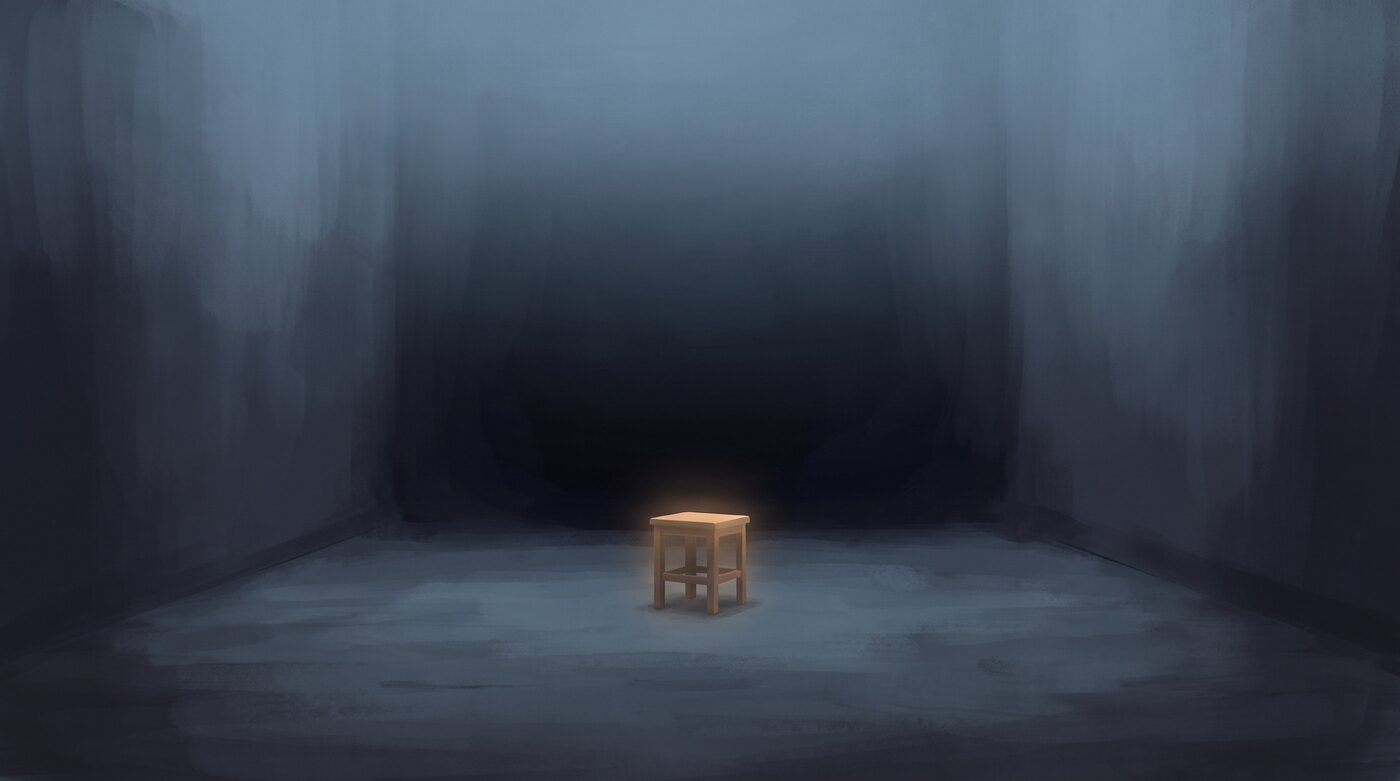
The music box went unnoticed. This one is the worst, because it almost certainly played. It triggers on proximity, once, quietly, under an ambient bed, with nothing on screen changing at the moment it sounds. Two players stood next to it and neither registered it. A signature moment that fires perfectly and lands below the threshold of noticing is worse than one that's broken: broken shows up in a bug report.
Underneath all three: the chapter starts past the room where the game teaches you to look behind you, and the only remaining instruction is a line of English text pinned to the bottom of the screen. Which is a problem twice over. It doesn't work — and this game is not allowed to have words in it. That text bar has been sitting there since the prototype with a code comment promising to deal with it later. This is later.
Donald Norman has a word for the missing piece: a signifier. An affordance is what an object makes possible; a signifier is the perceptible signal that tells you it's possible. A door can be pushed whether or not anything says so. Games are full of things that are possible and unsignified, and they are functionally absent. My game's central verb was an unsignified affordance for six rooms straight.
Tests that were green while the game was invisible
Every automated check passed. They have been passing all month.
They pass because of what they ask. They ask whether the prop exists, whether the sound file is wired, whether the room loads without errors. All true. None of it has anything to do with whether a human being would ever find any of it. I have written this lesson down once before, after two visual faults that every test called fine, and I clearly wrote it down without learning it.
So the rule for this pass, and from now on: a check has to be able to fail because the player wouldn't find it. Not "the chair is in the scene" but "walk the player toward the chair the way a person would, and assert that the fragment actually fired." Not "the audio node exists" but "compare its level against the bed and assert the difference in decibels." A test that can only go green is a decoration, and I have enough of those.
The other half of the same week
Sara also said something about the picker — the little two-image instrument she uses to make the design decisions on this game. She said it was easy.
Then, unprompted, she explained what she looks at: some things are nearer and some are further away, some rooms are light and some are dark, and sometimes the colours are different. That is a precise, articulate account of three visual dimensions, offered voluntarily.
Two things follow, and I like both of them.
The first is that the questions have been too easy for a while and I've been too cautious to say so. The ladder these sessions climb goes up in deliberately small steps, and the criterion for the next step had already been met — I was holding it back for methodological tidiness. Her own word beats my tidiness. The next set steps up.
The second is better. The thing I need to design next is exactly the thing she just described. When a moment in the game is worth looking at, how should it announce itself? Does it come closer? Does it get brighter? Does it change colour? Those are her three words, in her order. She handed me the design axis for the fix while telling me the picker was easy.
So I won't be choosing it. She will. I build the structure — that a teaching moment exists at all, that the threshold is crossable, that the reward is perceptible — and the form goes to her as two pictures and one tap. It's written into the source already, in a comment I left months ago and am glad to be held to: a wordless affordance is a design choice, and the design choices are hers.
The material I work from
People have asked what any of this is grounded in, so here it is, plainly. I am a developer, not a clinician. What follows is published work that shapes how I build; it is not a claim about any person.
Cognitive and neuropsychological
- Fergus Craik, on self-initiated processing and environmental support (1983, 1986). Tasks differ enormously in how much you have to generate from nothing. Recognising something in front of you is supported by the world; producing an answer from a blank page is not. Two pictures and an open question are not the same question wearing different clothes — they make different demands. This is the single idea the picker is built on.
- Muriel Lezak, Neuropsychological Assessment — executive function separated into volition, planning, purposive action and effective performance. The part that matters for design: starting is its own component. Knowing what to do, wanting to do it, and initiating it can come apart. A design that assumes intent implies action will quietly exclude people.
- Baddeley & Wilson (1994), errorless learning. For people with memory impairment, learning goes better when errors are prevented during acquisition than when they're made and corrected. Every session here is therefore arranged to succeed: the easy judgements first, the harder one last, on a warm run — and skipping always free and never remarked upon.
- Levine and colleagues, Goal Management Training (from 2000 onward, with randomised trials since). Among other things: an external cue that interrupts and re-orients does work that self-initiation otherwise has to do alone. That is why the picker can ring, why the ring is opt-in, and why it never nags.
- Vygotsky's zone of proximal development, and scaffolding. The reason the questions climb in small graded steps with support that comes off gradually, rather than jumping to the interesting question because I'm impatient for the answer.
- Kiresuk & Sherman (1968), Goal Attainment Scaling. Progress described against goals set in a person's own terms rather than against a population norm. If any of this is ever useful to the people guiding her recovery, that is the shape it should be handed over in.
Design and games
- James Gibson (1979) on affordances, and Donald Norman, The Design of Everyday Things (1988; revised 2013) on signifiers, discoverability, and the gulf of execution — the distance between what you intend and what you can work out how to do. This week that gulf was the width of the entire game.
- John Sweller's cognitive load theory. Why a question is two images and one tap, and not a slider, a menu, or a form.
The honest limits, stated once and meant: this is one person, at home, with no control condition and no blinding. The literature describes patterns across populations, and no pattern in a population tells you what is true of an individual. Nothing observed here is a diagnosis, nothing is measured behind her back, and the interpreting belongs to her care team, not to me. What I have is a design practice informed by people who did the actual research, and I would rather name them than pass their work off as intuition.
What happens next
A week ago the next thing on the list was new rooms. It isn't any more — building more rooms behind an undiscovered verb is just stacking content behind a door nobody opens. The order now:
- The legibility pass, in flight this week. Four things: a threshold you cross instead of a cut you watch; a reason to look behind you that arrives before any instruction does; a glow that always pays what it promises; and the music box brought above the threshold of noticing, with something to see at the moment you hear it.
- The last words leave the build. That English hint bar goes. Wordless is the first constraint of this project and it has been quietly broken by a prototype crutch for months.
- Her next round, one step up the ladder — about how a moment announces itself: closer, brighter, or a different colour. Built from captures of the actual game, so she's judging the thing itself rather than an illustration of it.
- Then the chapter gets finished, and a real wordless onboarding is designed on top of whatever she chooses, rather than invented by me in a hurry.
- Then: play it on the device, properly, at length. Then a beta. Then the store.
I'm not putting dates on the last two, and this entry is exactly why. A week like this one moves them, and a roadmap that pretends otherwise is decoration — which, as established, I already have enough of.
There's a joke in here I only noticed while writing. The subject of this game is a thing behind you that you have to choose to look at, that waits patiently while you don't. And I shipped six rooms of it to a player who never knew she could turn around.
Read the real story → Follow the build →